Deep Learning

TaylorShift: Shifting the Complexity of Self-Attention from Squared to Linear (and Back) using Taylor-Softmax featured image

TaylorShift: Shifting the Complexity of Self-Attention from Squared to Linear (and Back) using Taylor-Softmax

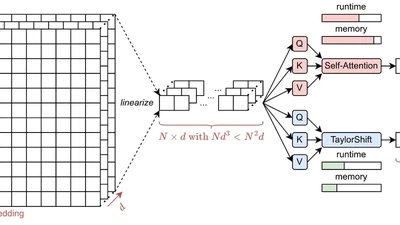
Oral presentation at ICPR 2024 introducing TaylorShift, a novel reformulation of the attention mechanism using Taylor-Softmax that enables full token-to-token interactions in linear time.
avatar
Tobias Christian Nauen
Just Leaf It: Accelerating Diffusion Classifiers with Hierarchical Class Pruning featured image

Just Leaf It: Accelerating Diffusion Classifiers with Hierarchical Class Pruning

arXiv
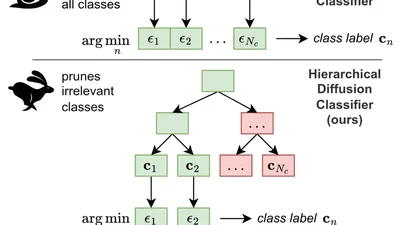
We speed up diffusion classifiers by utilizing a label hierarchy and pruning unrelated paths.
arundhati-s-shanbhag
PDF
Distill the Best, Ignore the Rest: Improving Dataset Distillation with Loss-Value-Based Pruning featured image

Distill the Best, Ignore the Rest: Improving Dataset Distillation with Loss-Value-Based Pruning

arXiv
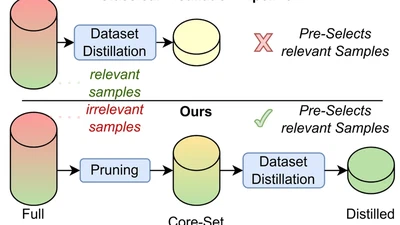
We improve dataset distillation by distilling only a representative coreset.
brian-bernhard-moser
A Low-Resolution Image is Worth 1x1 Words: Enabling Fine Image Super-Resolution with Transformers and TaylorShift featured image

A Low-Resolution Image is Worth 1x1 Words: Enabling Fine Image Super-Resolution with Transformers and TaylorShift

arXiv
We utilize the TaylorShift attention mechanism for global pixel-wise-attention in image super-resolution.
sanath-budakegowdanadoddi-nagaraju
PDF
Albatross featured image

Albatross

At its core, Albatross is a research project in the area of continual learning.
SustAInML featured image

SustAInML

SustainML is dedicated to creating a sustainable ML framework for Green AI. By prioritizing energy efficiency, SustainML aims to pave the way for environmentally conscious AI solutions that are both efficient and effective.
Sustainable Embedded AI featured image

Sustainable Embedded AI

Energy- and data-saving methods for environmental perception in embedded AI systems using the case study of smart factory and smart farming applications; funded by the Carl Zeiss Foundation.
Explaining Graph Neural Networks featured image

Explaining Graph Neural Networks

Bachelor Thesis
We extend and test KEdge, an interpretable-by-design approach for graph neural networks, and compare it to gradient-based attribution techniques.
avatar
Tobias Christian Nauen